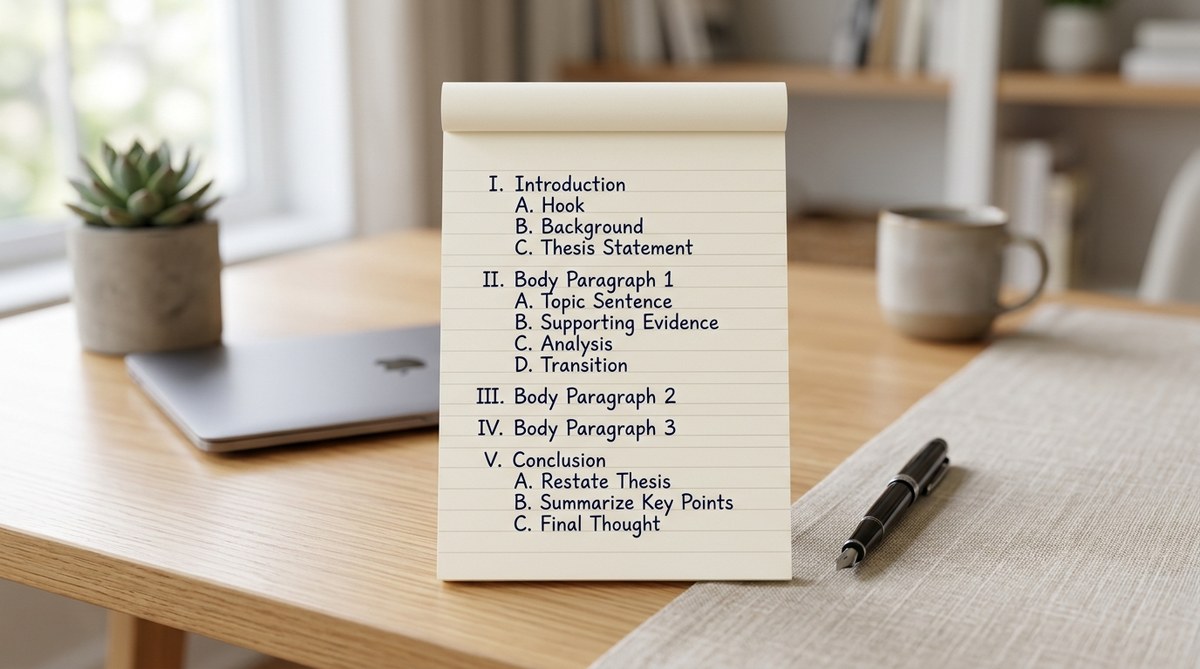
The Ultimate Essay Outline Template That Works for Any Topic
Staring at a blank page is one of the hardest parts of writing an essay. You know you have ideas somewhere in your head, but getting them onto the screen in a clear order feels impossible. That is where a strong essay outline template changes everything. An outline acts as your roadmap. It turns a messy pile of thoughts into a structured argument that flows from start to finish. Whether you are writing for a freshman composition class or a senior seminar, having a repeatable system saves time and reduces stress.
An essay outline template gives you a clear structure for any writing assignment. It helps you organize your thesis, body paragraphs, and supporting evidence before you write the full essay draft. This guide provides a universal template that works for argumentative, persuasive, analytical, and expository essays. You will learn the four main parts of an outline, common mistakes to avoid, and get a fill-in-the-blank template you can use starting today for better grades and confidence.
What Makes a Good Essay Outline Template
An outline is not just a list of bullet points. It is a planning tool that shows the logical flow of your argument. A good outline template includes space for your thesis statement, topic sentences, supporting evidence, and transitions between ideas.
When you use a consistent structure, your brain starts to think in patterns. You stop worrying about organization and start focusing on the quality of your ideas. That is the real power of a template. It handles the scaffolding so you can focus on the content.
Most students who struggle with essays do not have a writing problem. They have an organization problem. They jump into the introduction without knowing what their second paragraph will say. A template forces you to see the whole essay before you write any single part. That forward visibility is what separates a strong paper from a rambling one.
If you want to boost your essay writing skills, starting with a solid outline is the single best habit you can build.
The Four Building Blocks of Any Essay Outline
Every academic essay follows the same basic architecture. Once you learn these four parts, you can adapt them to any assignment.
1. The Introduction
Your introduction has one job: get the reader to care and tell them what you will argue. A standard introduction contains a hook, some background context, and your thesis statement. In your outline, you only need to jot down the hook idea and the thesis. You do not need full sentences yet.
2. The Body Paragraphs
Each body paragraph covers one main point that supports your thesis. A typical essay has three to five body paragraphs. For each paragraph, your outline should include:
- A topic sentence that states the paragraph’s main idea
- Two to three pieces of supporting evidence
- A sentence that explains how this evidence connects back to your thesis
3. The Counterargument (Optional but Recommended)
Addressing the opposing side strengthens your argument. A counterargument paragraph shows your professor that you have considered other perspectives. In your outline, write down the strongest objection to your thesis and your response to it.
4. The Conclusion
Your conclusion restates your thesis in fresh language and summarizes your main points. It should leave the reader with something to think about. In your outline, note the key takeaway you want the reader to remember.
How to Build Your Outline in 4 Steps
Follow these steps to turn a blank page into a complete outline. Each step builds on the last one.
-
Write your thesis statement first. Everything else in your outline supports this single sentence. Make it specific and arguable. A good thesis is not a fact. It is a claim that someone could disagree with.
-
List your main points. Brainstorm the three to five key ideas that support your thesis. Do not worry about order yet. Just get them on the page. Each main point will become one body paragraph.
-
Add supporting evidence under each point. For each main point, write down the evidence you plan to use. This could be a quote from a source, a statistic, a historical example, or a personal observation. Be specific. Vague notes like “evidence about climate change” will not help you when you sit down to write.
-
Arrange your points in a logical order. Move your main points around until the sequence makes sense. Usually, you want to start with your second strongest point, save your strongest point for last, and place your weakest point in the middle.
For a more detailed walkthrough of the writing process, the 7-step framework for writing A+ essays shows you exactly how to move from outline to final draft.
The Universal Essay Outline Template
Here is the template that works for nearly every essay assignment. Copy this structure into your notes and fill in the blanks as you plan your next paper.
I. Introduction
– Hook: [One sentence that grabs attention]
– Background: [One to two sentences of context]
– Thesis: [Your main argument in one sentence]
II. Body Paragraph 1
– Topic sentence: [Main point of this paragraph]
– Evidence A: [Quote, fact, or example]
– Explanation: [How this evidence supports your thesis]
– Evidence B: [Second piece of evidence]
– Explanation: [How this evidence supports your thesis]
III. Body Paragraph 2
– Topic sentence: [Main point of this paragraph]
– Evidence A: [Quote, fact, or example]
– Explanation: [How this evidence supports your thesis]
– Evidence B: [Second piece of evidence]
– Explanation: [How this evidence supports your thesis]
IV. Body Paragraph 3
– Topic sentence: [Main point of this paragraph]
– Evidence A: [Quote, fact, or example]
– Explanation: [How this evidence supports your thesis]
– Evidence B: [Second piece of evidence]
– Explanation: [How this evidence supports your thesis]
V. Counterargument (Optional)
– Opposing view: [The strongest argument against your thesis]
– Your rebuttal: [Why this opposing view is weak or incomplete]
VI. Conclusion
– Restated thesis: [Your thesis in different words]
– Summary: [One sentence summarizing each main point]
– Final thought: [A broader implication or call to action]
This template is deliberately simple. You can expand it for longer papers by adding more body paragraphs or sub-points under each evidence section. The structure stays the same whether you are writing 500 words or 5,000 words.
Common Outline Mistakes and How to Fix Them
Even with a good template, students make predictable errors. The table below shows the most common mistakes and what to do instead.
| Mistake | Why It Hurts Your Essay | How to Fix It |
|---|---|---|
| Writing full sentences in the outline | You waste time polishing language before the logic is solid. | Use short phrases and keywords only. Save full sentences for the draft. |
| Skipping the counterargument | Your argument feels one-sided and less persuasive. | Add one paragraph that addresses the strongest opposing view. |
| Placing your weakest point first | Readers lose interest before you reach your best evidence. | Open with your second strongest point. End with your strongest. |
| Making the thesis too broad | You cannot cover everything, so the essay feels shallow. | Narrow your thesis to one specific claim. |
| Forgetting to connect evidence back to the thesis | The essay reads like a list of facts with no argument. | After each piece of evidence, write one sentence explaining the connection. |
These patterns show up in student essays every semester. If you recognize yourself in any of them, you are not alone. Reviewing common essay writing mistakes can help you catch issues before your professor does.
How to Adapt This Template for Different Essay Types
The universal template works for most assignments, but different essay types need small adjustments. Here is how to tweak it for the three most common formats.
Argumentative and Persuasive Essays
For argumentative essays, the counterargument section becomes essential. Your goal is to convince the reader to agree with your position. Strengthen your outline by adding a rebuttal paragraph that directly addresses the strongest opposing argument. Your body paragraphs should each present one distinct reason why your position is correct.
If you want to master persuasive essay writing, focus on building each body paragraph around a single logical claim supported by evidence.
Analytical Essays
Analytical essays break down a text, event, or idea into its parts. Your thesis should state what your analysis reveals. Each body paragraph should examine one element of the subject. For a literary analysis, that might be character, setting, and symbolism. For a historical analysis, it could be economic, social, and political factors.
Expository Essays
Expository essays explain or inform. They do not argue a position. Your thesis should state what you will explain. Each body paragraph covers one category or aspect of the topic. The counterargument is optional and usually not needed unless the assignment requires it.
“The time you spend on your outline is never wasted. A good outline cuts your writing time in half and doubles the clarity of your argument. Most students who skip the outline spend hours staring at the page. Those who outline first write faster and get better results.” — Dr. Sarah Mitchell, Professor of Composition at Arizona State University
Matching Your Evidence to Your Thesis
Your outline is only as strong as the evidence you choose. A common mistake is picking evidence that sounds interesting but does not actually support your thesis. Every piece of evidence in your outline should pass this simple test: “Does this fact or quote make my main argument more convincing?”
If the answer is no, cut it. Even if you found the source after hours of research. Even if the quote sounds impressive. Irrelevant evidence weakens your argument because it distracts the reader from your main point.
When you review your outline, check each body paragraph for alignment. Does the topic sentence support the thesis? Does the evidence support the topic sentence? Does the explanation connect the evidence back to the thesis? If any step in that chain is broken, the paragraph will feel disconnected.
Should You Use Digital Tools or Paper for Your Outline
Some students prefer a physical notebook. Others like digital tools. Neither option is wrong. The best method is the one you will actually use.
- Paper outlines work well if you like to draw arrows, circle ideas, and move things around freely. A blank sheet of paper and a pen give you total flexibility.
- Digital outlines are easier to edit and rearrange. Google Docs, Word, and dedicated outlining apps like Workflowy or Dynalist all work well.
- Hybrid approach works for many students. Start with a brain dump on paper, then transfer your organized points into a digital template.
Try all three methods at least once. Stick with the one that feels most natural.
Your Blueprint for Better Essays
An essay outline template is not a crutch. It is a tool that experienced writers use every single time. Professional authors, journalists, and academics all outline their work before they write. There is no reason for students to do it differently.
The template you learned here will work for your next assignment, the one after that, and every paper you write through graduation. Print it out. Save it to your notes. Keep it open in a separate tab while you write.
Start with the thesis. Then fill in your main points. Add the evidence. Arrange the order. When you sit down to write the actual essay, you will not be starting from zero. You will be expanding a plan that is already solid.
Use your outline as your guide. Stick to it when you feel the urge to wander off topic. Trust the structure you built. Your future self will thank you when the essay practically writes itself.